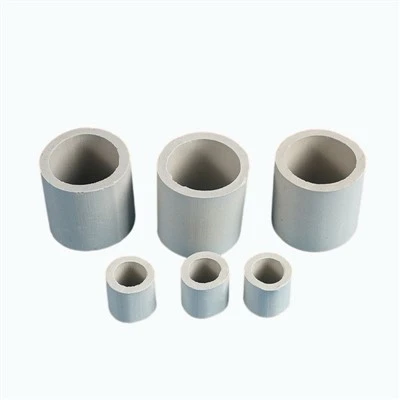
Ceramic rings are ring-shaped components made of ceramic materials, primarily used in reactors and transmission pipelines in industries such as chemical, metallurgy, and power generation. Depending on their shape and application, ceramic rings are classified into different types, such as packed ceramic rings, mesh ceramic rings, and skeleton ceramic rings.
Packed ceramic rings: Commonly used in gas absorption, drying, and purification processes, they improve gas-liquid contact efficiency and mixing uniformity, thereby increasing the reactor's reaction rate and efficiency.
Mesh ceramic rings: Based on packed ceramic rings, they have dozens of small holes punched into their surface. These holes allow for more uniform gas and liquid distribution, further improving reactor reaction efficiency.
Skeleton ceramic rings: Skeleton ceramic rings are the most basic type of ceramic ring component. They possess high mechanical strength and resistance to acid and alkali corrosion, and are commonly used in reactor equipment such as distillation columns, adsorption columns, and transmission pipelines.