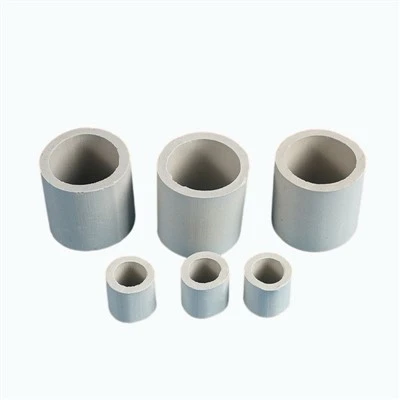
Ceramic rings, seemingly simple, are actually miniature masterpieces of materials science. Their basic formulation typically includes three core raw materials:
Mineral framework: Kaolin accounts for approximately 60%-70%, providing plasticity and a foundation for sintering.
Reinforcing agent: Alumina is added at 15%-25%, enhancing hardness and corrosion resistance.
Auxiliary material system: Quartz sand adjusts the coefficient of thermal expansion, and feldspar lowers the sintering temperature.
Interestingly, the microscopic morphology of the raw material particles directly affects the porosity of the finished product-spherical particles can form 20% more uniform micropores than angular particles.
Different raw material ratios are like cooking recipes; subtle changes can alter the properties of the finished product:
When the kaolin purity is >95%, the compressive strength after sintering increases by 30%.
When the alumina particle size is controlled at 5-10μm, wear resistance reaches an ideal balance.
Adding 3%-5% zirconium oxide can significantly improve thermal shock resistance.
Laboratory data shows that when the silicon-to-alumina ratio in the raw materials reaches 2.1:1, the ceramic ring exhibits optimal acid and alkali resistance.
Modern ceramic ring raw material selection follows a triple matching principle:
Operating Condition Matching: Low-iron, high-silicon formulations are used in acidic environments.
Process Matching: Dry pressing requires controlling the raw material moisture content to 5%-8%.
Cost Matching: For civilian-grade products, calcined kaolin can partially replace alumina.