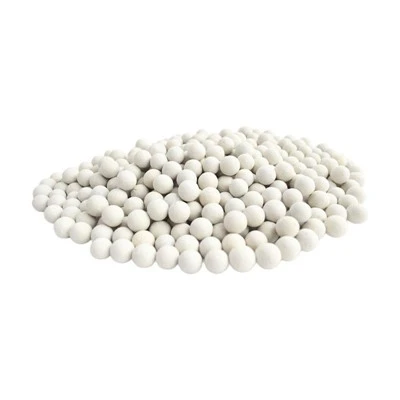
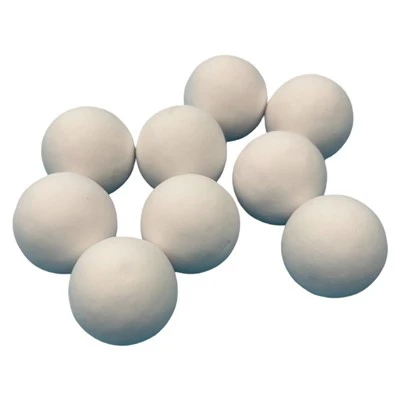
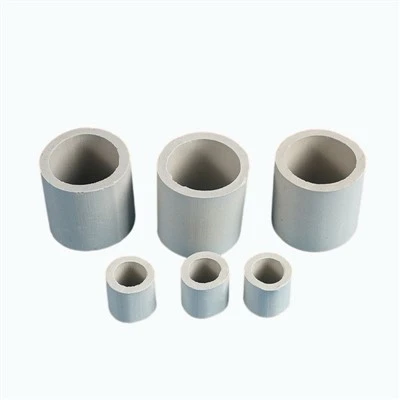
The main chemical properties of inert alumina ceramic balls (taking Al₂O₃ content of 23-30% as an example) include Al₂O₃+SiO₂ >92%, Fe₂O₃7, acid resistance ≥98%, alkali resistance ≥82%, and operating temperature >1400℃.
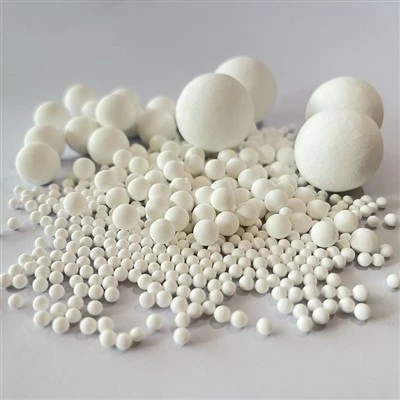
The compressive strength of inert ceramic balls varies with size, with typical reference values as follows: 6mm diameter >0.45 KN/ball (or >55 kg/ball), 13mm >1.67 KN/ball (or >170 kg/ball), 25mm >6.22 KN/ball (or >635 kg/ball), 50mm >9.8 KN/ball (or >1000 kg/ball).
Ceramic balls can be classified into different types according to their material and performance. High-alumina ceramic balls are mainly made of high-alumina raw materials, focusing on high hardness, high wear resistance, and corrosion resistance. Inert ceramic balls prioritize superior chemical stability, high-temperature stability, and thermal shock resistance, exhibiting high strength and high chemical stability.
Open-cell ceramic balls and grooved open-cell ceramic balls are spherical packing materials created by modifying the shape of inert ceramic balls. They possess high porosity, low pressure drop, and high-throughput hydrodynamic characteristics, effectively improving the porosity and specific surface area of the packing layer and enhancing gas-liquid dispersion performance.