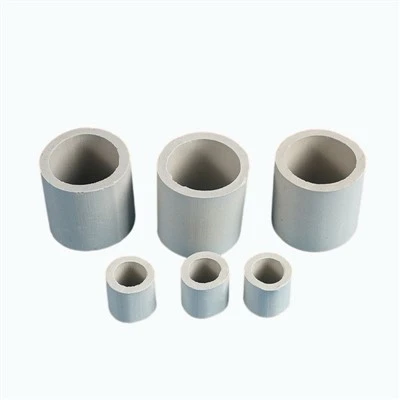
Ceramic rings are key components widely used in chemical, power, and machinery manufacturing industries, and their performance directly affects the operating efficiency and service life of equipment. In practical applications, the scientific and rational selection of ceramic rings has become a key concern for users. The selection of ceramic rings requires comprehensive consideration of multiple aspects, including material properties, structural design, operating environment, working conditions, and cost-effectiveness. First, the functional requirements of the ceramic ring must be clearly defined based on the specific application scenario.
For example, ceramic rings operating in high-temperature environments should prioritize materials with excellent high-temperature resistance, such as alumina or silicon nitride; while ceramic rings used in corrosive media environments need to possess good chemical stability, such as zirconium oxide or silicon carbide. Second, the structural design of the ceramic ring must also match the actual working conditions. Common types of ceramic rings include annular, tubular, and block shapes, with different shapes suitable for different sealing, support, or insulation requirements. When selecting, the space constraints and installation method of the equipment must be considered to ensure that the ceramic ring can be stably embedded or fixed. Furthermore, the operating temperature range, load-bearing capacity, wear resistance, and other performance indicators of the ceramic ring must also be strictly controlled. For high-temperature and high-pressure applications, it is essential to ensure that the ceramic ring can maintain structural integrity and functional stability under extreme conditions. Simultaneously, attention must be paid to the surface treatment process of the ceramic ring, such as coating and sintering processes, as these affect its durability and anti-fouling capabilities. In the actual selection process, users are advised to refer to relevant industry standards and product technical parameters, and conduct comparative analysis based on the operating requirements of their own equipment. Furthermore, the dimensional accuracy and tolerance control of the ceramic ring are also crucial factors that cannot be ignored. High-quality ceramic rings typically exhibit high dimensional consistency, which helps improve assembly efficiency and reduce the risk of failure due to dimensional deviations. During the procurement process, attention should also be paid to the supplier's technical support and after-sales service capabilities to ensure that necessary guidance and assistance are available during use. In conclusion, selecting the appropriate ceramic ring requires not only a comprehensive understanding of its material properties, structural characteristics, and applicable scenarios, but also a comprehensive evaluation of various factors based on specific application needs, ultimately leading to a scientifically sound and reasonable decision.